Conversational AI: Current State and Future Trends in 2025
Do you remember the excitement we felt a few years ago when we first encountered smart voice assistants? Siri and Google Assistant, yes, Siri could answer simple questions to very bad jokes that made us all amused. With the development of artificial intelligence, it's been more than just a couple of years that the progress blew our minds. Now, not a single day goes by where we as humans are not colliding with Conversational AI — from voice assistants on our smartphones to customer service robots and even ChatGPT that can code, write code, or art. Conversational AI is slowly changing the way we live and work.
This transformation extends beyond mere technical improvement. It represents a fundamental shift in how we engage with technology, replacing rigid command-response patterns with fluid, intuitive exchanges. Across industries from healthcare to finance, these systems now serve as invisible digital companions that anticipate needs and provide assistance without the jarring limitations of earlier generations.
In this blog, we'll dive into today's conversational AI ecosystem, unpack the key innovations driving more human-like exchanges, and reflect on the implications for our future as AI becomes increasingly woven into the fabric of daily life.
What is Conversational AI?
Conversational AI — means the human like AI capable of communicating back and forth using natural language. Born of natural language processing, machine learning and cognitive computing technologies it allows computers to read, reason and respond in language, thereby creating near-human conversational experience. As opposed to a conventional command-based interaction, conversational AI permits the user to articulate themselves from a natural level and conversational like when speaking to a human being. The evolution of this technology went from basic rule based chatbots to sophisticated systems having context, talking to database of answers and showing some level of emotional intelligence.
Conversational AI: Within Reach by 2025!
From Novice to Expert: AI Conversational Abilities Have Leaped Forward
Do you have a fondness for AI assistants couple of years ago? If you asked them for the weather, they may tell you only what happened on this day historically; if you told them to write a story it would have tons of imperfections. Today's conversational AI is not just a few years old and able to understand complicated questions, with professional-level responses.
Small Models Can Have Great Wisdom
In the past, only those "big shots" with hundreds of billions of parameters could perform well. It's like saying only a "strongman" could lift heavy weights. In 2022, the smallest model that achieved 60% accuracy in multi-task language understanding tests had 540 billion parameters (PaLM). By 2024, Microsoft's Phi-3-mini model, with only 3.8 billion parameters, achieved the same performance, reducing the model size by 142 times in just two years!
What does that mean? It seems like evolving from a "strongman" to "expert in technique". Good AI power is not available in super computers anymore; even the consumer laptop & smartphone runs fairly well AI model. It is like moving from "luxury gym equipment" to home-use dumbbells that anyone can afford and make use of.
AI Usage Costs Are Plummeting
Do you remember how expensive early AI services were? For models reaching GPT-3.5 levels, the cost of a single million-token query plummeted from $20 in November 2022 to $0.07 in October 2024, a decrease of over 280 times in just 18 months. The inference prices for large language models across different tasks have seen annual declines ranging from 9 to 900 times.
And it's like going from "high-end restaurant" to street food, from luxury goods to home-use laundry detergent. Nowadays, AI services become as free as water and electricity a necessity infrastructure where all can access with an affordable price.
The Application of Conversational AI in the Real World: Transforming Various Industries
By 2024 the rate of people engaging AI is increasing to is up from 55% in 2023 to 78% which is very literally one in every four people using AI already! What is more impressive is that the adoption of generative AI, significantly doubled from 33% to an over-whelming 71% on average across businesses. This shift is to evolve from "early adopters" to "standard configuration" where AI will be part of how work and lives are done — in real time.
Coming to market size, the figures will take your breath away: By the end of 2025 the AI chatbot market in China is set to hit 98.5 billion RMB! The global text-to-speech market is estimated to value $5.5 billion, and the forecasted surge is set at a staggering pace by 2031 to hit the USD 13.4 billion. Everyone behind these numbers is the real thing, and AI: magically transforming every piece of our life.
Challenges and Concerns: Surge in AI Abuse Incidents
The development of conversational AI, on the other hand, has not been without hiccups. In 2024, a new record of 233 AI-related harm incidents was reported by the AI incident database, with a rise of 56.4% compared to 2023. Narratives common in such typical cases entail deepfakes private images, chatbots that supposedly led to youth suicides.
The ethical considerations and regulatory trends in conversational AI are evolving rapidly in several key dimensions. First, new industry standards are establishing clear transparency requirements, mandating AI systems to explicitly disclose their artificial nature and operational limitations. Additionally, frameworks for fairness are being widely implemented to address and minimize algorithmic bias across AI applications. Data sovereignty has also gained significant attention, with enhanced user control over personal data, including strengthened informed consent processes and data portability rights. Furthermore, accountability mechanisms are being developed to clearly define the boundaries of responsibility between AI systems and human supervisors. These developments collectively reflect a growing emphasis on responsible AI development and deployment in conversational systems.
Future Outlook: Exciting New Trends in Conversational AI
From Conversation to Action: The Evolution of AI Agents
In 2025, conversational AI will no longer be satisfied with simple question-and-answer interactions; it is evolving into true "agents." So, what exactly is an agent? Simply put, it is an AI system capable of making autonomous decisions and completing complex tasks.
From "Conversational Interaction" to "Task Closure"
We used to call AI before mostly with questions and a simple chat but now with the help of AI, that takes your requisition and do several other action a at a time to complete the tasks. For instance, "I want to book a flight to New York next Monday and under $500," the AI will source out flights, prices and cut them and book it, and even add the itinerary to your calendar.
According to the latest RE-Bench evaluation, top AI systems have outperformed human experts by four times in short tasks (2 hours) — despite still being outperformed by humans in long tasks (32 hours) and performing many an expert level task (ai writing specific code) providing better efficiency.
Multimodal Large Models: AI's Comprehensive Perception Ability
Another important trend for 2025 is the prevalence of multimodal AI. multimodal means that AI can work with data of the same type, such as images, text or audio.
And this means… Let me take an example like think of giving AI a photo, it not only recognizes the content of the photo but can get context and have a real meaningful conversation with you. You would show it a mountainous landscape and ask, "Is this safe enough for children?" AI will do a light analysis of factors like the hillside and height, ranges of services nearby — providing the best advice it can.
Multimodal AI makes human-computer interaction more natural and intuitive, truly achieving "instant understanding" of human intentions. According to Google's "2025 AI Business Trends" report, multimodal AI will unleash the powerful potential of context, integrating multi-source data to enhance accuracy and user experience.
AI Development Paths: Super Entry Points and Vertical Applications
Super Entry Points: General AI assistants turn into the ordinary entry point for all services
General AI assistants get excellent conversational AI capabilities, and we will all steer clear of different services via one single point of entry on those fluent applications. No matter if you are looking up, shopping or ordering food, cooking in your kitchen, done control of smart home appliances or content creation — a single AI assistant can be used to go about any of the tasks, no need to switch applications.
In the past, search engines, social media, and super apps were the main gateways for people to access information and services, but now AI assistants are becoming the new "super entry points." This explains why tech giants like Microsoft, Google, Yahoo, and others are actively developing their own AI assistant products.
Development of Vertical-domain Specific Agents in Short Time
Alongside general AI assistants, we are now seeing rapid advancements on vertical domain specific agents as well. As the specific field driven AI entity, these targeted services are supposed to be more professional and profound.
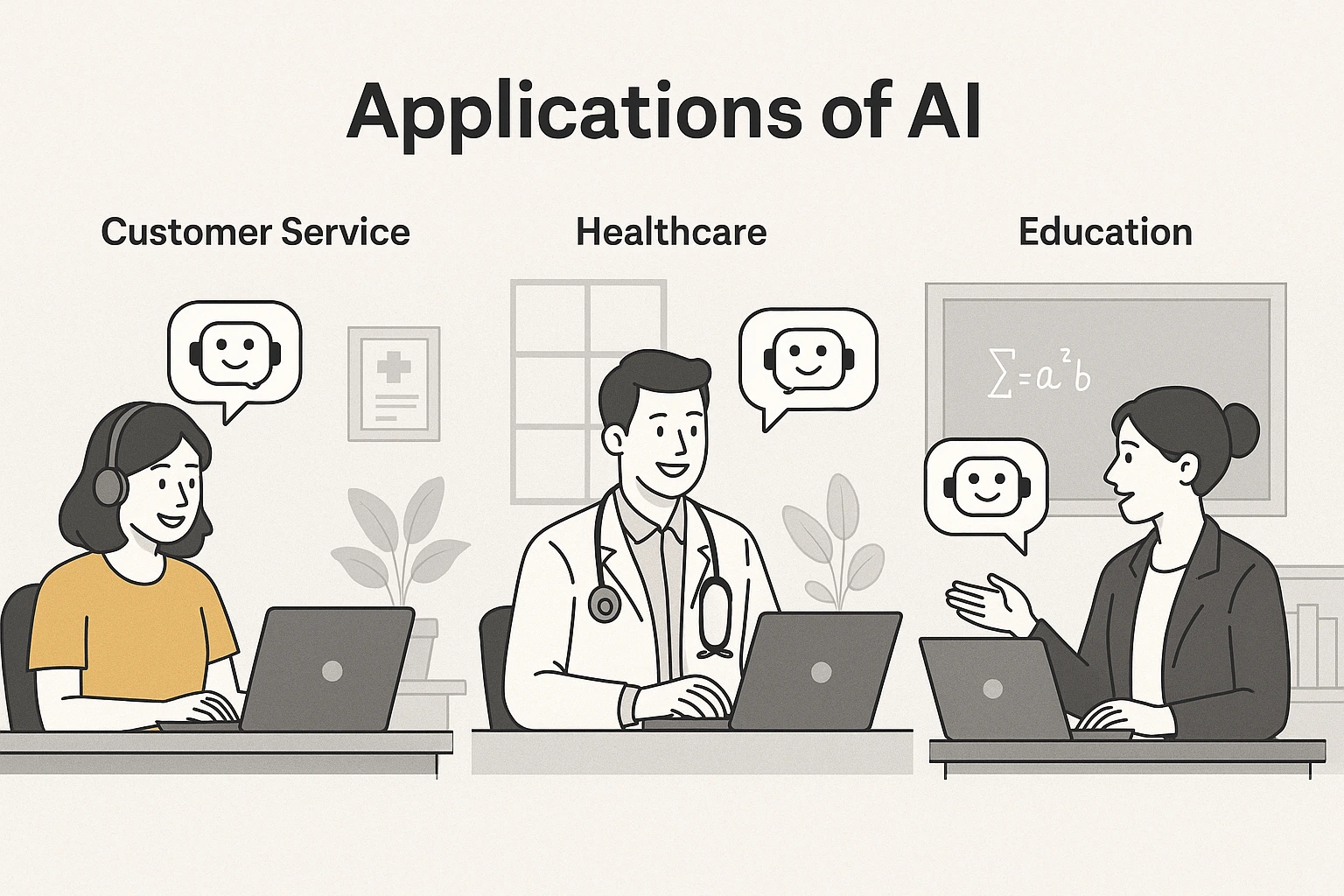
In 2025, we will see further development of conversational artificial intelligence in legal services, education, real estate, and more specialized application areas:
- Legal: AI reads case, drafts documents; predicts outcome of judgement for both plaintiffs and defendants.
- Healthcare: AI-powered Virtual assistants will support patients in making appointments, answer medical questions, remind on medication and assist on the mental solving.
- Education, AI powered chatbots function as teaching aids and answer queries from students, provide customized learning to individual students, and also help teachers out by automating a lot of admin duties.
- Real Estate: AI can help buyers to: filter properties, Chara Reiterate valuation of a house and find out the modification result thanks created house-buying agent which simplifies the process and lessens anxiety.
- Entertainment: The main changes in entertainment will be as follows Content discovery will be enhanced using AI, it will provide personalized recommendations and offer interactive storytelling experiences and AI powered customer service over streaming services and gaming platforms.
Text-to-Speech Technology: Making AI Speak
The Breakthrough in Text-to-Speech Technology
Conversational AI — (one of them component) is Text-to-Speech (TTS) Technology, which turns cold texts to warm voices and provides people a human-like experience in human machine interaction.
Take text-to-speech technology, which has reached impressive heights by 2025.
From Mechanical to Natural: The Voice Quality Revolution
Remember those early, rather mechanical voices that we'd done annoyingly stiff navigation software voices? Today's AI voices are difficult to distinguish from real humans. The latest text-to-speech technology not only simulates natural intonation and emotion but also adjusts speaking speed, pauses, and emphasis based on content, making AI voices sound more natural and fluid.
Spark-TTS as an example, this Text-to-speech voice synthesis of 2025 provided five languages (English, French, Japanese, Chinese, Korea) and had 18 voice timbres. It can synthesize speech in live on ordinary CPUs at high quality while speech generation on GPUs rates 50 times real-time.
What is more astonishing, it only needs 82M parameters that is dozens of times smaller than earlier voice synthesis systems, yet the voice generated sounds much more natural.
Support for Multiple Languages and Voice Customization
Saving for text-to-speech technology in 2025, progress has been made notable progress in the area of Language Support. We already have over 140 languages supported by Vidnoz AI, from common ones like English Chinese and Japanese down to less common ones such as Welsh or Swahili — we have the native speaker pronunciation.
More importantly, users can customize voice characteristics according to their needs. Want a gentle female voice or a deep male voice? Young and energetic or mature and steady? Fast and passionate or slow and soothing? All these can be adjusted through simple settings. Some advanced tools even allow users to upload their own voice samples to create personalized AI voice clones.
Low-Cost, High-Efficiency Content Creation
Improvements in text-to-speech technology has drastically lowered the cost and barrier to producing audio content. Use to produce an audiobook professionally was expensive, and lengthy because you needed expensive recording gear together with a model voice(s). Now, anyone can leverage text-to-speech tools to rapidly create high-quality audio content from text.
QY Research predicts that the global text-to-speech AI model market will see $5.504 billion in sales for 2024 and hit $13.42 billion by end-2031, clocking annual growth rate of 15.3%.
Widespread Application Scenarios for Text-to-Speech
Content Creation and Voiceovers
AI text-to-speech technology has managed to transform the landscape of content creation. Whether it's a blogger, podcast host or video creator, AI can be used to craft professional narration and voiceovers without the writer having to record herself represented a huge win for content creation productivity.
Audiobooks and E-Learning
text-to-speech technology has transformed audiobooks and e-learning. Publishers can quickly have the books converted to audiobooks and educational institutions can overlay course materials with voice over in a matter of minutes, making learning more flexible, different
For the blind and those who have reading disabilities, text-to-speech technology enables them to gain more windows into knowledge. They can autonomically obtain information by listening whether less interactive and convenient but does to some extend make access to information more efficient.
Voice Assistants and Chatbots
Text-to-speech technology plays a key role in voice assistants, chatbots. Siri, Alexa, Cortana and other kinds of intelligent assistants all based on text-to-speech for turning delivered text information into speech outputs. As the tech is superior, these assistants' voices getting more natural, can talk more with rich emotion and tonal variations for human-like machine interaction experience.
Customer Service and Navigation
In the customer service field, text-to-speech technology is widely applied in automated voice response systems, providing 24x7 uninterrupted service. In navigation and automotive applications, text-to-speech technology provides drivers with clear voice navigation instructions, reducing visual distractions and improving driving safety.
Text-to-Speech Technology Deployment Methods
Depending on different application requirements, text-to-speech technology can be deployed in multiple ways:
Cloud-Based Services
Cloud deployment is the most common method, where users access text-to-speech functionality through API calls to cloud service providers. This approach eliminates the need for complex local software installation, offers low maintenance costs, and provides continuous access to the latest technological updates.
Representative products: Amazon Polly, Google Text-to-Speech AI, Microsoft Azure TTS AI, etc.
On-Premises Solutions
For scenarios with strict data privacy requirements or those needing offline usage, on-premises deployment is a better choice. Although initial setup may be more complex, it allows complete control over data flow and can be used in environments without network connectivity.
Representative products: Mozilla TTS, Coqui TTS, and other open-source solutions.
Embedded Applications
For resource-constrained devices such as smartwatches and smart speakers, lightweight text-to-speech engines optimized for embedded environments can be used. While these engines may have relatively simplified functionality, they can provide sufficiently good speech synthesis results with limited computational resources.
Representative products: Various lightweight TTS engines customized for IoT devices.
Recommended Conversational AI Platforms: Your Daily Assistants
After learning about the current state, trends of conversational AI, and text-to-speech technology, you might be eager to experience these intelligent tools firsthand. Below, we'll recommend several conversational AI websites worth trying in 2025.
General Conversational AI Platforms: Your Daily Assistants
1. ChatGPT: The Most Popular AI Conversation Platform
Introduction: Developed by OpenAI, ChatGPT is currently the most popular AI conversation platform, widely regarded as the best artificial intelligence chatbot for general purposes. It can understand and generate natural language, answer questions, create content, and even write code.
Suitable for: Students, Professionals, Creators, Developers—almost everyone can benefit from it.
Practical tips:
- The more specific your questions, the more accurate the answers
- You can ask ChatGPT to output content in specific formats (such as tables, outlines)
- For complex tasks, ask step-by-step, guiding the AI through the process
2. Botpress: A Customizable Conversational AI Platform
Introduction: Botpress is a multifunctional artificial intelligence conversation platform, with its main feature being unlimited customization and expansion. It provides a visual drag-and-drop canvas, automatic translation supporting over 100 languages, and pre-built integrations with popular software and channels.
Suitable for: Enterprise users, Developers, Professionals needing Customized AI assistants.
Practical tips:
- Use the visual interface to create professional-level AI assistants without programming
- Can be integrated into websites, social media, or internal enterprise systems
- Supports multiple languages, suitable for international businesses
3. DeepSeek: A Leading Domestic AI Conversation Platform
Introduction: DeepSeek is a leading AI conversation platform in China, with a low entry barrier and excellent conversation quality, particularly suitable for Chinese users. It excels in Chinese language understanding and generation, with a deeper understanding of Chinese culture and localized content.
Suitable for: Students, New professionals, Users needing Chinese language services.
Practical tips:
- Good understanding of Chinese idioms, poetry, historical allusions, etc.
- Can be used to translate Chinese-English documents with good results
- Supports image understanding; you can upload images for analysis or questions
Enterprise Solutions: Reliable Assistants for Business Applications
1. IBM watsonx Assistant: Enterprise-Level Customer Service Solution
Introduction: IBM watsonx Assistant is a conversational AI platform specifically designed for customer service applications, capable of building virtual and voice assistants. It leverages artificial intelligence and large language models to learn from customer interactions, improving problem-solving efficiency and reducing customer wait times.
Suitable for: Enterprise Customer Service Teams, IT Support Departments.
Practical tips:
- Supports multi-channel deployment (websites, applications, phone systems)
- Provides detailed analytical reports to help optimize customer service processes
- Can seamlessly transfer to human customer service representatives
Application case: A bank used IBM watsonx Assistant to build an intelligent customer service system handling common transactions such as account inquiries and transfer confirmations. The system processes over 10,000 conversations daily, resolving 90% of customer issues and reducing average wait times from 15 minutes to just seconds.
2. SmartChat Assistant: Ideal for Website Integration
Introduction: Powered by QuickBlox, SmartChat Assistant provides an efficient and user-friendly platform for creating AI-driven chatbots and integrating them into websites and applications.
Suitable for: Website administrators, Small business Owners.
Practical tips:
- Offers plug-and-play WordPress plugins
- Supports real-time human takeover functionality
- Can collect visitor information to help with sales conversion
Application case: A small travel agency integrated SmartChat Assistant into their website to help visitors inquire about travel packages, prices, and booking procedures. The chatbot processes approximately 200 conversations daily, improving customer satisfaction while increasing booking conversion rates by 20%.
How to Choose the Right Conversational AI Tool
When faced with numerous options, how do you find the conversational AI tool that best suits your needs? Here are some suggestions:
- Clarify your requirements: Is it for daily assistance, content creation, customer service, or other specific purposes?
- Consider your budget: Are free tools sufficient for your use, or do you need to pay for premium features?
- Technical threshold: Do you need programming knowledge? Is there a user-friendly interface?
- Language support: Does it support the languages you need? How well does it handle your preferred language?
- Privacy and security: How is your data processed? Does it comply with relevant regulatory requirements?
Remember, the best tool is the one that best fits your specific needs. Consider starting with free versions to get familiar with the technology before deciding whether to upgrade to paid versions.
Conclusion: Embrace AI, But Remain Rational
With the rapid development of conversational artificial intelligence technology, we stand at the threshold of a new era. AI is no longer a concept from science fiction but a practical tool that has integrated into our daily lives. From helping us answer questions and create content to converting text into natural speech, conversational AI is changing how we interact with technology.
In 2025, conversational AI has made remarkable progress: breakthroughs in small model performance, significantly reduced usage costs, enhanced multimodal capabilities, and the evolution of AI agents from conversational interaction to completing full task cycles. These advances have not only made AI more powerful but also more accessible, allowing ordinary users to easily enjoy the convenience brought by AI.
However, we should also maintain a rational attitude. The increase in AI misuse incidents reminds us that technology itself is neutral, and how it is used depends on humans. We need to consider the ethical issues of AI, establish reasonable regulatory frameworks, and ensure that this powerful technology benefits humanity rather than causing harm.
As ordinary users, we can start now by trying the conversational AI tools recommended in this article and exploring their applications in learning, work, and life. Whether it's a general conversation platform like ChatGPT or a text-to-speech tool like ElevenLabs, they can bring efficiency improvements to our daily tasks.